

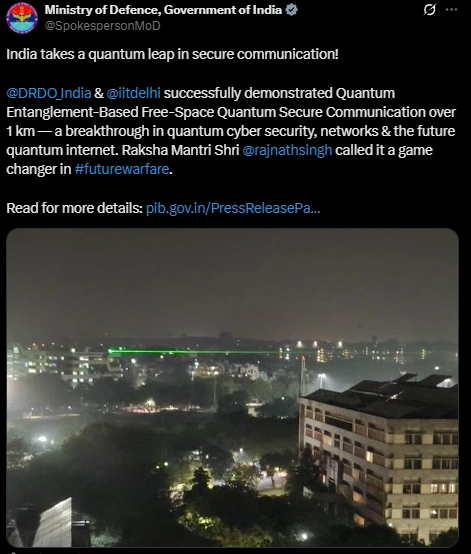
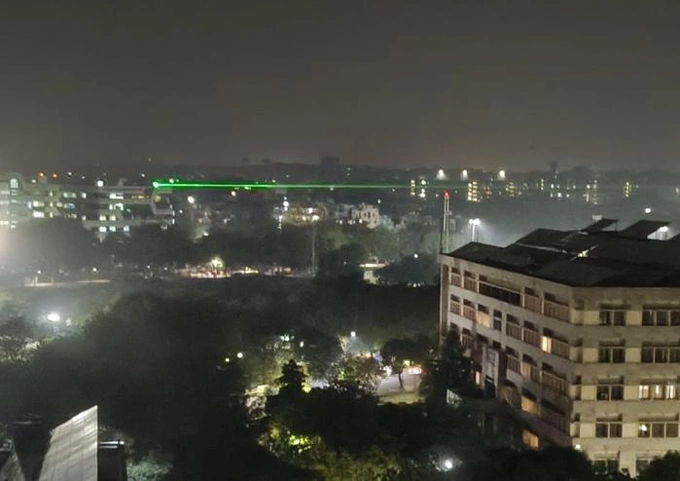
HIIT Delhi's Defence Research and Development Organization (DRDO)-Industry-Academia Centre of Excellence (DIA-CoE) has used quantum entanglement to demonstrate free-space quantum secure communication over a distance of over one kilometer via an optical link. In the realm of cybersecurity, the development is regarded as a significant breakthrough.
WATCH THE VIDEO HERE..
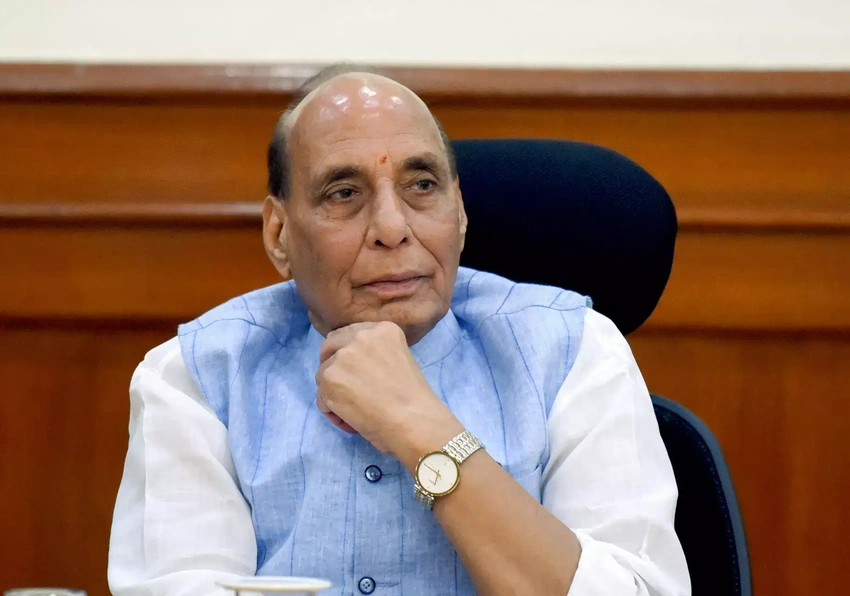
Congratulating DRDO and IIT-Delhi, Defence Minister Rajnath Singh said the accomplishment marks India's entry into a new quantum era of secure communication, "which will be a game changer in future warfare."
With a quantum bit error rate of less than 7%, the experiment, which was carried out on the campus of IIT Delhi, achieved a secure key rate of almost 240 bits per second.
According to the Defense Ministry, "this entanglement-assisted quantum secure communication paves the way for real-time applications in quantum cybersecurity, including long-distance Quantum Key Distribution (QKD), the development of quantum networks, and the future quantum internet."
The Scenario
The demonstration, which was given by Prof. Bhaskar Kanseri's research group in front of several dignitaries, was part of the project "Design and development of photonic technologies for free space QKD," which was approved by the Directorate of Futuristic Technology Management of DRDO. The Ministry stated that the efforts were in line with India's larger goals to advance quantum technologies for the country's development.
“Quantum entanglement-based QKD offers several significant advantages over the traditional prepare-and-measure method by enhancing both security and functionality. Even if devices are compromised or imperfect, the use of quantum entanglement ensures the security of key distribution. Any attempt to measure or intercept the entangled photons disturbs the quantum state, allowing authorised users to detect the presence of an eavesdropper,” it said.
The Ministry said quantum communication provided fundamentally unbreakable encryption, making it a dual-use technology with applications in securing data in strategic sectors such as defence, finance, and telecommunications, as well as in protecting national security-related communications.
“Free-space QKD eliminates the need to lay optical fibres, which can be both disruptive and expensive, especially in challenging terrains and dense urban environments,” the Ministry said.
The Larger Context
In 2022, DRDO scientists and Prof. Bhaskar's team demonstrated India's first intercity quantum communication link between Vindhyachal and Prayagraj using commercial-grade underground dark optical fiber. In another project funded by the DRDO, the team used entanglement to successfully distribute quantum keys across a 100-km spool of telecom-grade optical fiber in 2024.

Through DIA-CoEs, 15 of which have been established at prestigious academic institutions like universities and IITs, and IISc, these technologies are being developed.
Conclusion
India has achieved a significant milestone with the DRDO-IIT Delhi experiment, which is its most sophisticated entanglement-based free-space quantum communication test to date. Previously restricted to laboratories and fiber cables, this has now spread outdoors. India gets closer to a future where communication is not only faster but also impenetrably secure with every light pulse transmitted over that one-kilometer link. The country is at the beginning of a quantum-enabled era, based on vision, commitment, and creativity, as scientists scale, improve, and get ready to aim high, literally with satellite integration.
#QuantumCommunication #Cybersecurity #DRDO #IITDelhi #FutureTechnology
