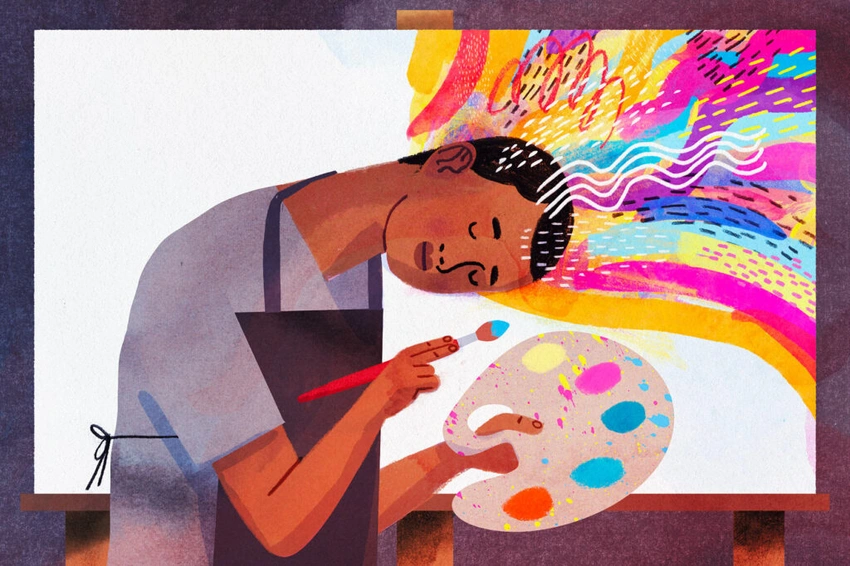
I’m starting to fear that my life isn’t tragic enough to be a successful artist.
I went to a gallery opening in the city last night. It was one of those pristine, white-cube spaces where the air conditioning is always set to "refrigerator" and everyone is drinking cheap wine out of plastic cups while looking very expensive.
I stood in front of a piece in the center of the room. It was a pile of dirt. Just... dirt. Maybe some gravel. It was arranged in a neat little square on the concrete floor.
Visually, it didn’t do much for me. I looked at the texture. I looked at the lighting. I tried to feel something, but mostly I just felt like I was looking at a construction site accident.
Then, I read the little white placard on the wall.
The "Bio" explained that this soil was collected from the specific coordinates where the artist’s childhood home stood - on an actual construction site - before they were abused and forced to work in it by their parents. The gravel represented the fragments of childhood they experienced - far in between.
I had expected it to feel like a PR stunt, but instead I was taken aback. The room shifted. A lump formed in my throat. I looked back at the dirt, and it wasn't dirt anymore, it was grief. It was loss. It was powerful.
But on the train ride home, a quieter, sadder thought crept in: my art means nothing in comparison.
And that terrifies me.
The Most Important Thing in the Gallery isn't the Art
In the contemporary gallery scene, the narrative (who you are, your trauma, your identity) is often valued higher than technical skill or visual impact.
The Tyranny of the "Statement"
I am currently in my third year of art school. I spend about 30 hours a week in the studio. I am obsessed with the smell of turpentine. I obsess over the viscosity of oil paint. I study light. I study lit. I want to make things that stop you in your tracks because of how they look.
But every time we have a critique in class, the professors don't ask me about my brushwork. They don't ask about the statement.
They ask: "What is your narrative?" They ask: "How does this situate your identity within the current socio-political climate?" Our final assignment is to create five social media posts with narratives on our art that get at least 5 likes each.
It feels like we are being trained to be writers first, and visual artists second. We are taught that the image is just a vehicle -- a delivery system -- for our biography.
The Press Release Problem
There is a strange pressure in the art world right now to monetize our trauma. If you want to get into a show, you need a "hook." You need a story. You need to explain who you are and why you have the right to make this image.
If I paint a flower because it’s beautiful, I am told it’s "decorative." If I paint a flower and write a 500-word essay about how the flower represents my struggle with a chronic illness, suddenly, it’s "High Art."
Don't get me wrong, context is beautiful. Identity is vital. The stories of where we come from matter deeply.
But I worry that we have tipped the scales too far. We have reached a point where the visual impact of the work -- the actual art part of the art -- is becoming secondary to the text beside it. We are creating illustrations for press releases. We are making visual footnotes for our biographies.
Can Art Just Be... Art?
I’m sitting in my studio right now, looking at a canvas I’ve been fighting with for two weeks. It’s a painting of my kitchen sink.
There is no tragedy in my kitchen sink. There is no great political upheaval in the way the light hits the dish soap. I can’t write a three-paragraph essay about how this sink represents the collapse of western civilization or my own personal demons.
It’s just a sink. It’s just the way the light caught the water, and for a split second, it looked like magic to me.
I want that to be enough.
I want to believe that we can still communicate through color and form alone. I want to believe that a painting can make you cry not because you read the label, but because the artist captured a vibration of the human experience that words simply cannot touch.
Visual art is supposed to speak the things that language can’t. If we have to explain it all in the bio, maybe we aren't painting loud enough.
