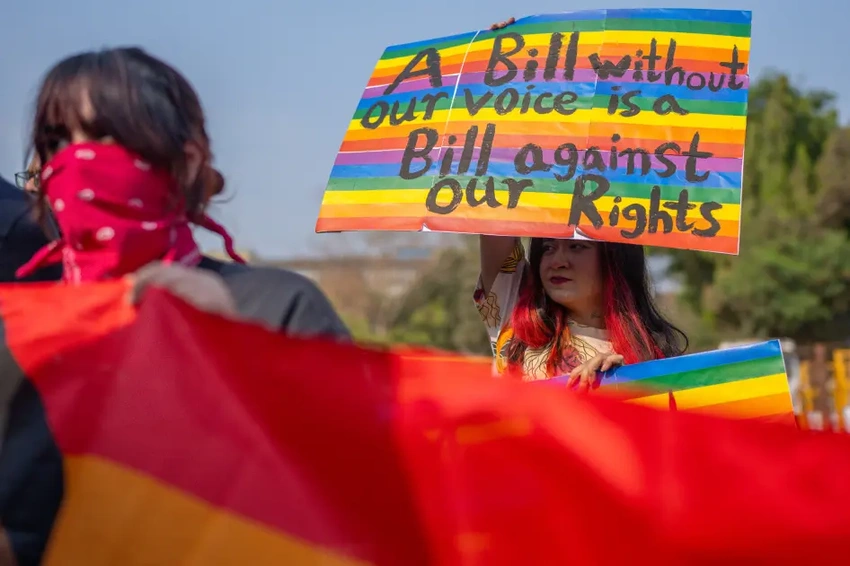

The 2026 amendment to the Transgender Persons Act fundamentally alters one thing that should never have been negotiable: self-identification. The earlier framework allowed a person to declare their gender. Now, that declaration has to pass through a medical board and administrative approval.
This is not just procedural tightening. It is a shift in power. Identity is no longer something you have—it is something you must prove.
And the definition itself has been narrowed. The law explicitly excludes “self-perceived identities” and collapses trans identity into a limited set of recognised categories.
So what is being taken away is not abstract—it is the right to exist on your own terms.
The scale of resistance and why it’s happening
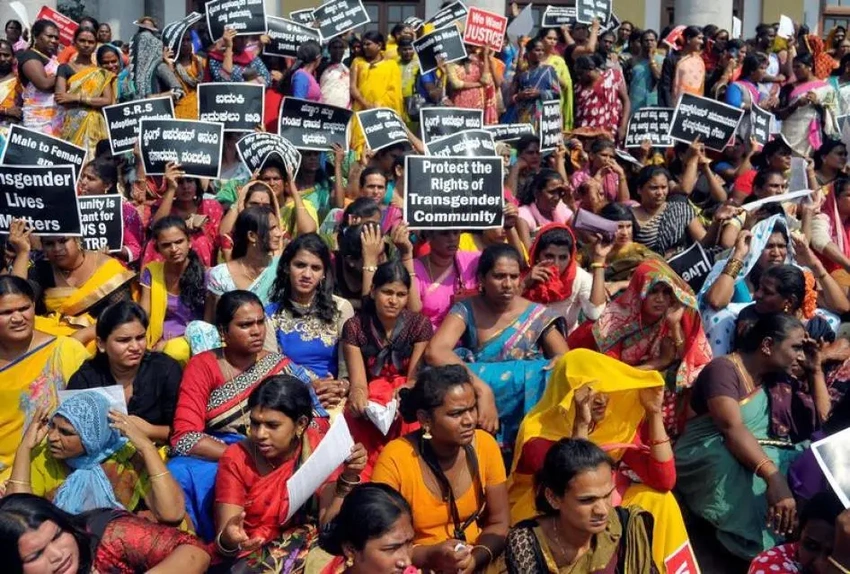
This hasn’t gone uncontested. Not quietly, not marginally.
Trans people across India have been protesting on the streets, in public hearings, in organised demonstrations. From Jantar Mantar to press clubs, the message has been consistent: you cannot legislate identity out of existence.
Even members of the National Council for Transgender Persons resigned in protest, explicitly stating that the community was not consulted and that their voices were ignored.
That detail matters. Because this is not just disagreement—it is structural exclusion. A law about a community, drafted without that community.
What is being said inside Parliament
What makes this moment sharper is that the critique is not just coming from outside. Inside Parliament, figures like Renuka Chowdhury have been unusually direct.
She pointed out the basic hypocrisy: no one asks cisgender MPs to prove their gender to a medical board, so why impose that burden on trans people?
But more importantly, she has framed the Bill within its political moment.
This is happening at a time when:
- India has been dealing with LPG shortages, with supply concerns and policy pressure to shift to alternatives
- There is ongoing instability linked to the Iran-Israel conflict, affecting oil prices, inflation, and economic anxiety
- The rupee and stock markets have been under stress, tied to global conflict and domestic pressures
The question raised inside and outside Parliament is simple: why this Bill, right now?
Not in a vague sense of “timing,” but in a very material one. When fuel prices, supply chains, and economic insecurity are pressing concerns, a deeply contentious identity law becomes the centre of debate.
That is not accidental. It reshapes what the public is talking about.
What the law actually does to people
There is a tendency to keep this debate abstract, but the consequences are not.
If identity requires medical verification:
- People are forced into invasive scrutiny
- Access to documents becomes harder
- Welfare, healthcare, and jobs become conditional
And because the definition is narrower, many will simply fall outside it altogether.
So this is not just about dignity (though it is that too). It is about access. About who gets to be counted, and therefore who gets to survive within systems that require documentation for everything.
The contradiction at the centre
The state’s argument is about clarity and preventing misuse. But that logic rests on suspicion—that people will falsely claim trans identity for benefits.
What is striking is how disproportionate that fear is compared to lived reality. There is no evidence of widespread “misuse” driving systemic failure. What does exist, consistently, is marginalisation, violence, and exclusion.
So the law ends up solving a hypothetical problem while intensifying a real one.
What this moment reveals
This is no longer just about a Bill. It is about how identity is being redefined in relation to the state.
On one side: a framework where gender is self-known.
On the other: a system where gender must be verified, certified, and approved.
The amendment clearly moves toward the latter.
And that is why the resistance is so widespread—not just from politicians, not just from activists, but from trans people themselves across the country. Because what is being contested is not a clause or a policy detail.
It is the right to say: this is who I am—and not have that statement placed on trial.
Are you who you say you are—or who we decide you can be?
#TransRights #IndiaNews #LGBTQ+ #SelfIdentification #HumanRights
