

Ryan Coogler’s Sinners arrives like a found folktale: equal parts blues lament, pulp revenge and supernatural parable. It is a film that insists on being read as much as watched, a text whose layers of form and history reward slow attention. The director’s choice to set the action in 1932 Clarksdale, Mississippi, and to centre a pair of returning twins who attempt to open a juke joint, situates the film squarely in the Southern Gothic tradition while also complicating that tradition with genre-bending virtuosity.

Plot and moral architecture
At the story’s core are Elijah “Smoke” and Elias “Stack” Moore, veterans whose homecoming is not a simple restorative journey but a confrontation with history that is personal and communal. Their plan to found a space of music and refuge immediately reads as an act of cultural reclamation, but Coogler subtends this with an insistence on the uncanny: the past is not merely remembered, it returns in bodily, often violent, form. The film’s vampiric horror elements are less about monsters-as-plot and more about sin as contagion, the way social violence consumes and reconfigures human bonds. Summaries and critical appraisal confirm this tonal and thematic synthesis.
Form and style
Formally, Sinners is audacious. Coogler deploys shifting aspect ratios, textured cinematography and a score that reads as character as much as accompaniment; the blues is not decoration but the film’s organising principle. Autumn Durald Arkapaw’s cinematography, coupled with Ludwig Göransson’s music, produces a sensory grammar that asks viewers to feel history in the bones. The film’s hybrid of musical set-pieces and horror sequences gives the narrative a ritualised quality: performances are exorcisms, and frames are altars. Reviews and technical notes emphasise the film’s technical ambition and its status as a genre-defying work.
Characters and performance
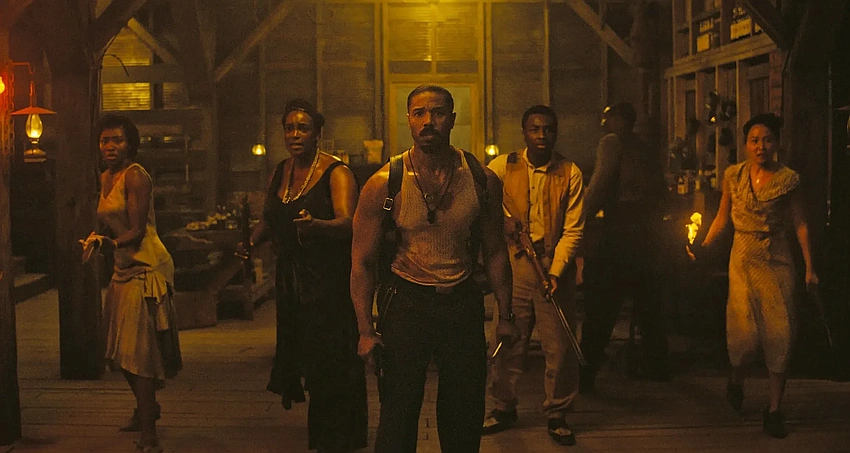
Michael B. Jordan’s dual turn as the Moore twins operates as an acting thesis on doubleness and division. Twinship in Sinners becomes a metaphor for the split subject loyalty to kin and the claim of the wider community, memory and forgetting, violence and tenderness. Supporting performers, notably the younger singer-figure and key community members, function as chorus and conscience, articulating the social stakes of the twins’ endeavour.
Blues, Hoodoo and the politics of form
Reading Sinners as literature means attending to its intertexts. The film summons the longue durée of Black Southern expressive culture: blues as elegy and insurgency; Hoodoo as pragmatic theology and counter-history; the juke joint as both refuge and site of contested meaning. Coogler’s text seems to insist that forms of cultural labour (song, ritual, storytelling) are themselves modes of resistance. The spectral antagonism that threatens the juke joint reads, then, as the afterlife of slavery and the carceral logics that follow.

On violence, redemption and the ethics of spectacle
A temptation with films that traffic in historical suffering is to collapse suffering into spectacle. Sinners resists a simple indictment or vindication; it stages brutality without aesthetic flinching, but refuses nihilism by persistently foregrounding music, care and collective memory as modes of repair. The film asks difficult aesthetic questions: when does representation risk reproduction of trauma, and when does it become a vehicle for communal witnessing? Coogler’s answer is oblique rather than didactic. He offers ritual, not sermon.
As a literature student, what feels most generative about Sinners is its refusal to settle. It is less a film with an argument than a text that keeps opening its seams: historical freight and formal invention tug at one another until something new, fragile, combustible emerges. Readers and viewers will find themselves returning to it not to close meaning but to keep a conversation alive: about music as history, about community as resistance, about the spectral economies that continue to shape bodies and places. In that restless refusal to resolve, Sinners performs a small, stubborn kind of hope, the hope that stories, however stained, might yet be places of repair.

#CooglersSinners #SouthernGothic #1932Mississippi #JukeJoint #FilmReview #MovieReview #MichaelBJordan #Sinners
